Health Literacy Education Workshop

- 13 October 2026
- 8:00 AM – 3:30 PM
- Sidra Medicine, Tower D, Training Room (2D-200A)
Target Audience
Registration Fees: 190QAT
Registration Fee Policy: Registration fee is non-refundable and non-transferable once payment has been completed. By registering for the workshop, participants acknowledge and accept this policy.
CPD:
Category 1: 4.5 points
Category 3: 1.5 points
Overview
Sidra Medicine is hosting an engaging and informative Health Literacy Workshop designed to equip healthcare providers with the skills and strategies needed to effectively communicate with patients. The workshop aims to bridge the gap between complex medical information and patient understanding, ultimately ensuring better health outcomes and improved patient satisfaction.
Topics
This full day comprehensive workshop is thoughtfully designed to address key aspects
of health literacy, including:
- Understanding Health Literacy: Exploring fundamental concepts and their impact on healthcare delivery.
- Barriers to Learning: Identifying and addressing obstacles that hinder effective communication and patient understanding.
- Patient and Family Education: Developing strategies to support informed decision-making.
- Patient Engagement: Encouraging active participation in the treatment planning process.
- Medication Adherence: Promoting strategies to help patients understand and follow their medication regimens.
- Teach-Back Method: Empowering staff to confirm understanding by asking patients to explain instructions in their own words.
- Documentation: Highlighting the importance of clear and accurate documentation to improve patient comprehension and continuity of care.
Workshop Objectives
- To provide a comprehensive learning experience that emphasizes the importance of integrating health literacy skills into daily practice.
- To enhance participants’ ability to use effective communication techniques, such as plain language and the teach-back method, to improve patient outcomes and satisfaction.
- To equip participants with the tools and strategies needed to identify and address barriers to health literacy.
- To promote an inclusive approach to patient care, enabling participants to better engage with patients and their families.
Target Audience
- Nurses
- Physicians
- Allied Health Practitioners
- Pharmacists
Participants from the stated target audience are eligible to receive a total of 6 CPD points, comprising 4.5 Category 1 points and 1.5 Category 3 points.
Professionals outside of the stated target audience are welcome to attend this activity; however, they will not be eligible to receive CPD points.
Scientific Planning Committee






Main presenters

Guest speakers
Quality and Patient Safety Department
The Quality and Patient Safety department supports hospital-wide efforts to deliver safe, effective, and patient-centered care. As part of our mission to enhance patient safety, we recognize the critical role of health literacy in reducing preventable harm and improving outcomes.
Through our Patient Safety team, we promote clear communication between healthcare providers and patients. We also advocate for strategies that reduce misunderstanding of health information, and we collaborate with departments to embed safety practices into education and provision of care. We also support staff through safety training, event analysis, and system-level improvements that enhance both staff awareness and patient understanding.
By participating in the Health Literacy workshop, our department contributes to a safer care environment with the aim that all patients can better understand their health, make informed decisions, and actively participate in their care journey.
Department of Pharmacy
Our mission is to provide safe, effective, and compassionate care to our young and women population across all in-patient, outpatient, specialty, and clinical settings. We are dedicated to ensuring safe medication preparation and delivery, advocating, and advancing medication safety, leveraging cutting edge automation and technologies, and promoting optimal therapeutic outcomes through evidence-based practices.
As an integral part of the healthcare team, we empower patients, families, and caregivers through health education and improved health literacy, enabling informed decisions about their care. We are deeply committed to serving our community, advocating for accessible, patient-centered services that address the unique and diverse needs of every individual we serve
Nursing Research, Education, Professional Practice & Standards
The Department of Nursing Education and Professional Development delivers a comprehensive range of education, professional development, and orientation services to nurses, midwives, allied health staff, and students across Sidra. Committed to fostering a high-quality learning environment, the department aligns competency-based education, research, and evidence-based practice with the practical demands of clinical care, while addressing patient needs, environmental factors, and staff development. Additionally, it coordinates and facilitates clinical placement training for students from affiliated universities, hosts the nursing residency program, and supports a variety of educational activities, quality improvement projects, accreditation efforts, and certification initiatives.
Terms and Conditions
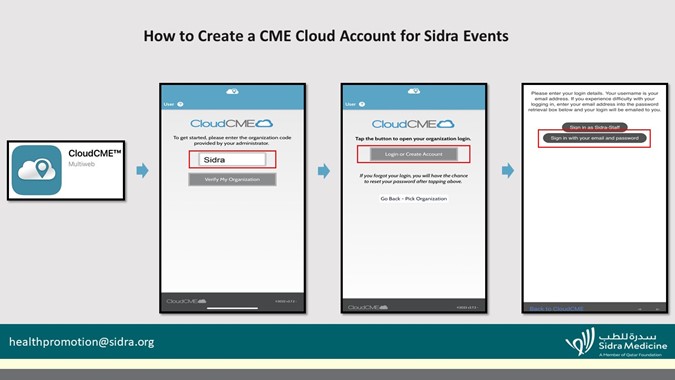
- Participants who are eligible for CPD points are required to download the Cloud CME application on their smartphones before attending the workshop. This will enable them to scan the registration QR code upon arrival. Certificates will be available on the app after completing the evaluation.
- Participants must attend the entire workshop to be eligible for CPD points. Those who do not complete the full duration of the workshop will not receive CPD points.
Late Comers’ Policy
Participants arriving more than 15 minutes late will not be allowed entry to avoid disruptions.
Contact us
Program Brochure
| Time | Session Title |
|---|---|
| 08:00 – 08:30 | • Welcome & registration • Information and Guidelines • Pre-Survey • Icebreaker Activity Speaker: Health and wellness education |
| 8:30 -9:15 | Health Literacy • Definition of health literacy • Impact of low health literacy on patients’ outcome • Activity (Mix and Match: Impact of Low Health Literacy activity) • Digital Health Literacy Speaker: Health and wellness education |
| 9:15-10:30 | Learning Barriers • Definition of learning barriers • Different types of learning barriers • Tools and strategies to overcome learning barriers • Activity(scenarios) Speaker: Health and wellness education |
| 10:30-11:00 | Health Literacy from patient safety Speaker: Quality and Patient Safety Department |
| 11:00-11:15 | Break (15 min) |
| 11:15-1:15 | Patient Education Journey • Effective communication between patients and health care providers • Activity: (Describer& Illustrator) • Learning needs assessment • Patient learning styles • Patient Education Materials • Activity: (Medical jargon) • Activity: (patient education material assessment) • Patient and family engagement • Video demonstrating the patient engagement Speaker: Health and wellness education |
| 1:15-2:00 | Lunch break (45 minutes) |
| 2:00-2:30 | Medication Adherence • Why is Adherence and Counselling Important? • What information should be given? • 5 Moments for Medication Safety • The importance of clear information • The importance of demonstration Speaker: Department of Pharmacy |
| 2:30-3:00 | Teach back • Teach back method definition • The purpose of using teach-back • Importance of using teach- back method • The teach-back process • Activity: (teach-back process) • Video demonstrating the Teach-Back method Speaker: Nursing Research, Education, Professional Practice & Standards Documentation The importance of Patient Education documentation Speaker: Health and wellness education |
| 3:00-3:30 | Conclusion • Summary and take away message • Post-Survey • Activity: (Kahoot competition) Speaker: Health and wellness education |
Our Insurance Partners
Our Insurance Partners