Customized Care: Baby Hugo’s cranial helmet – designed, delivered and fitted in just 11 days
19 May, 2026
 Watch Video
How our team’s rapid international coordination during a geopolitical crisis ensured uninterrupted specialized care for a baby in urgent need of a custom 3D-Printed Cranial Helmet.
Baby Hugo was diagnosed with metopic craniosynostosis, a congenital condition in which the bones of the skull fuse too early. The condition often causes a triangular forehead shape, known as trigonocephaly, and in some cases requires surgery to allow normal brain growth and skull development.
Hugo underwent a minimally invasive metopic synostectomy at Sidra Medicine on 23 February 2026. The procedure involved removing the fused metopic suture through a small incision.
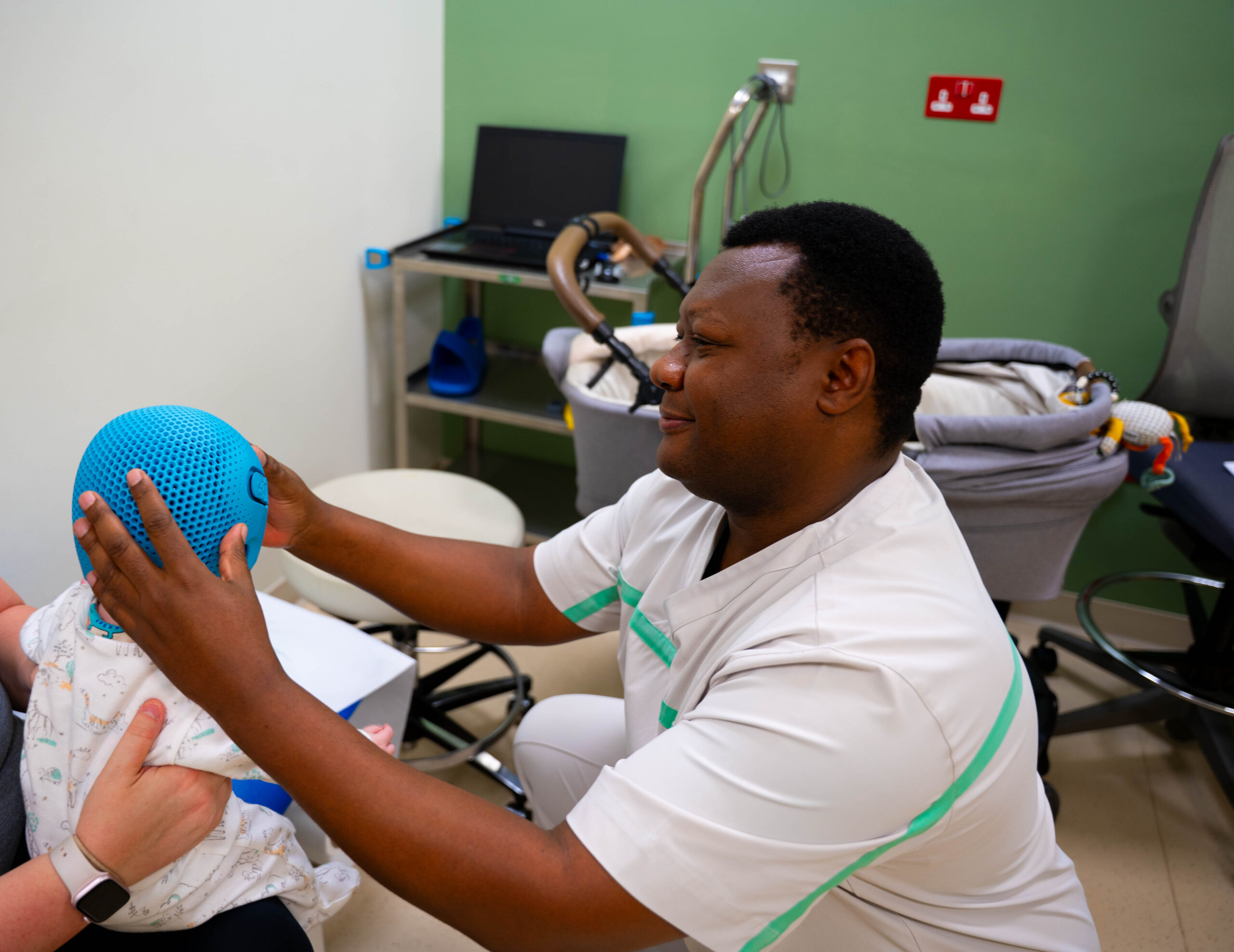
Following his surgery, Hugo was referred to Sidra Medicine’s Orthotics team for post-operative cranial helmet therapy. Helmet therapy plays an essential role in guiding skull growth during infancy and supporting long-term developmental outcomes.
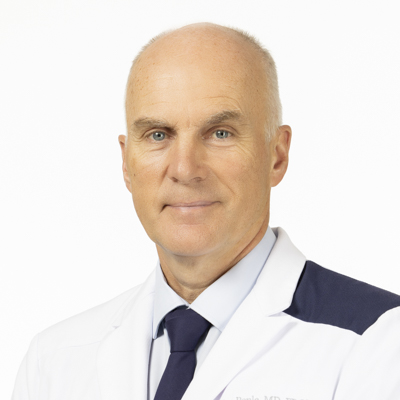
Dr Ian Pople, Division Chief of Neurosurgery at Sidra Medicine who performed Hugo’s surgery along with neurosurgeon Dr Khalid AlKharzi said: “Part of the postoperative treatment program for craniosynostosis requires helmet therapy to gradually reshape the skull as the baby grows. The helmets are custom-fitted to each child and work by guiding the natural growth of the skull into a more symmetrical shape. Hugo’s case is one of several we have successfully performed over the years. However, the timing of his procedure in March meant that we had to overcome geographical challenges, to ensure Hugo was fitted into a helmet on time.”
Uzma Jabeen, Orthotist at Sidra Medicine said: “Our cranial helmets are usually made by a supplier in the United States of America. However, at the time of Hugo’s referral in early March during the geopolitical crisis, airspace restrictions meant that delivery of his helmet was not possible. Babies’ skulls are incredibly malleable in the first year of life and timing is everything. The greatest potential for change is between four to eight months of age. Hugo was already five months old during this stage, and we urgently needed to find a solution.”
The team performed a 3D scan of Hugo’s skull and found an alternative solution in the Czech Republic. They coordinated with Invent Medical to design and produce Hugo’s custom 3D-printed helmet in just five days. The Logistics and Customs teams at Sidra Medicine then arranged expedited international shipping through neighboring countries (via air and land) to ensure the helmet reached Doha in time.
Julie Melville, Manager of Occupational Therapy at Sidras Medicine said: “From the initial scanning appointment to final fitting, the entire process was completed in only 11 days, an achievement that reflects the agility, collaboration, and patient-centered approach that continue to define healthcare delivery in Qatar, even during periods of global uncertainty. The level of collaboration required to deliver this care during such a challenging time was exceptional. From the clinical teams to our logistics colleagues, and the trust placed in us by Hugo’s family, this case reflects a truly collective effort to ensure the best possible outcome for our young patient.”
Hugo will be wearing his helmet for almost 23 hours every day for up to one year. The Orthotist team regularly meets his family to guide them through positioning strategies and sleeping adjustments.
For Hugo’s family, the successful delivery of the helmet represented a critical step in his recovery journey.
Hugo’s family said: “We feel incredibly fortunate to have received care at Sidra Medicine. Our son was treated by Dr. Ian and Dr. Khalid, who performed the surgery, and the support we received throughout the entire journey by the rest of the team has been outstanding. Following the procedure, we were concerned about potential delays in receiving the helmet due to the situation affecting deliveries. However, the team quickly introduced an alternative solution, and the new helmet has been fantastic. It is lightweight, and Hugo has adapted to it very well.”
They added: “From diagnosis to surgery, recovery, and helmet fitting, the team has supported us every step of the way. We are truly grateful for the care and dedication shown to our son. Thank you Sidra Medicine.”
For more details about Sidra Medicine’s neurosurgery and occupational therapy programs, please visit: www.sidra.org.
Related Clinics

Our Insurance Partners
Our Insurance Partners